
tutorial · 2024-11-14
Ground Fog, Mist and Atmospheric Effects in UE5 Niagara
Techniques for believable low-lying fog, ground mist, and atmospheric volume without killing performance or looking like a flat plane.
Why flat fog planes look cheap
A simple plane with a translucent material works for distant haze but fails for ground-level mist that should swirl around rocks and characters.
Good atmospheric effects use multiple layers: a base height fog volume, soft particle cards or flipbooks that respect scene depth, and subtle movement.
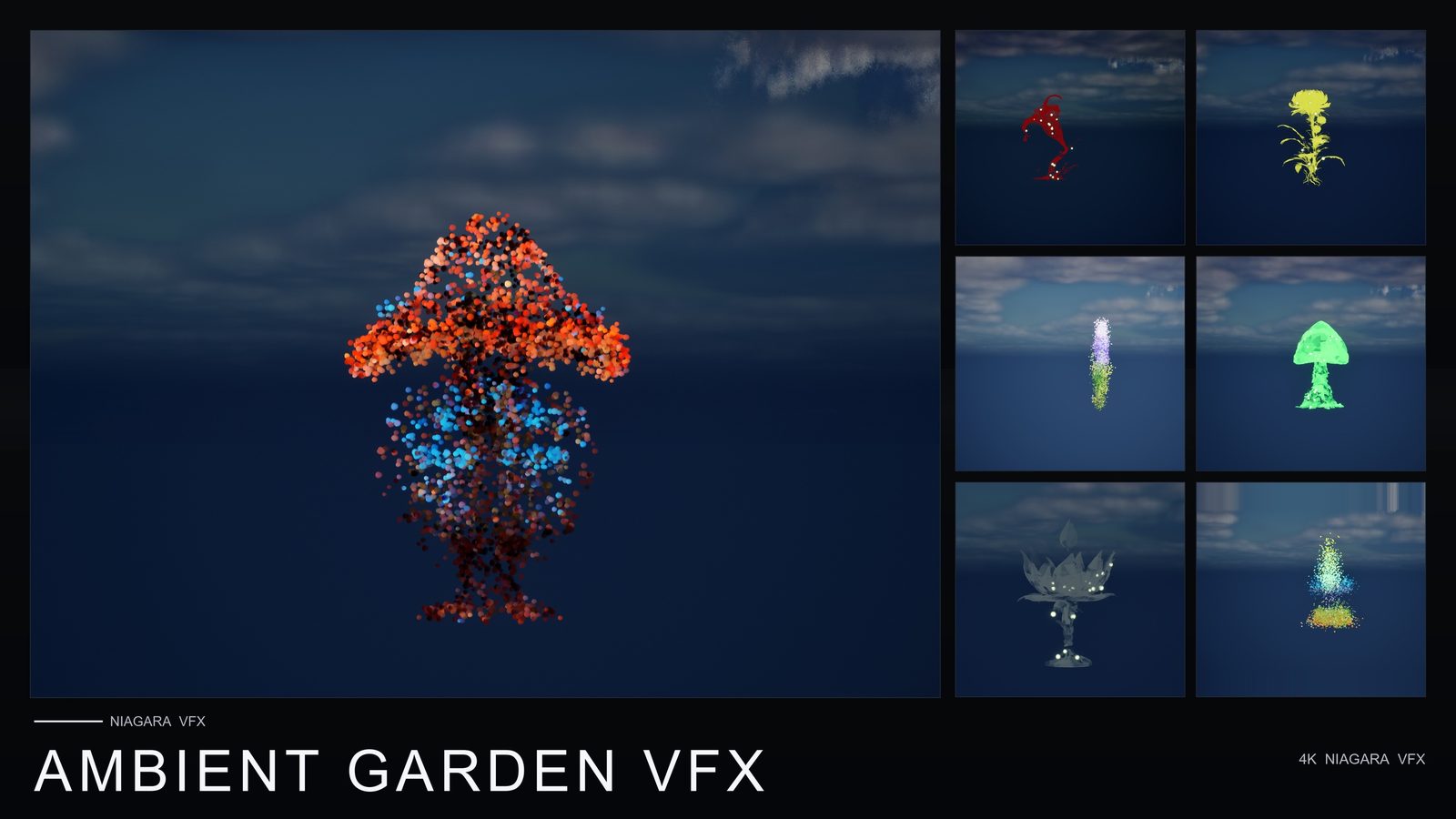
Packs like Ambient Garden VFX already solve the hard parts (bounded emitters, good materials, variation per flower/prop).
Practical authoring tips
Use 'Depth Fade' and 'Scene Depth' in the material so the mist thins correctly against geometry.
Keep emitter bounds tight and use multiple small systems instead of one giant one.
Add very subtle upward velocity + sine-based horizontal drift so the mist feels alive without obvious repetition.
Performance on large environments
Disable collision and complex modules for atmospheric mist.
Use lower spawn rates on distant or background systems.
Consider baking static mist cards into the environment for areas the player never gets close to.
FAQ
Should I use volumetric fog or Niagara particles?
Volumetric fog (Exponential Height Fog + Volumetric) is great for global atmosphere. Niagara particles or flipbooks are better for local, swirling, or prop-reactive mist.
Ambient Garden VFX
Bring outdoor scenes alive with 150 ambient Niagara effects — drifting pollen, fireflies, floating spores and mist — across 51 meshes and 131 material instances. CPU-simulated for Windows, Mac and Linux.
Related on Fab
Related reading