
article · 2026-06-24
Can AI Code Gameplay Systems? From Inventory to the Netcode Frontier
A walk up the code kitchen's difficulty ladder — where AI assistants finish the job, where they only scaffold, and the one system where they barely help at all.
So can AI actually code your gameplay systems?
The honest answer is: some of them, almost entirely, and one of them barely at all. That spread is the whole story. As part of our Games-as-Recipes study we broke games into 45 craft 'ingredients' across five kitchens and gave each an AI-build difficulty score from 1 to 5, where 1 means a code assistant can carry it close to end-to-end and 5 means expert, real-time craft that AI hardly touches. Those scores are our editorial assessment of what tooling can do today, not a measurement of anything, and they rate how automatable the parts are, not whether the result is any good. Buildable is not the same as fun.
The code kitchen averages 3.0, which puts it dead in the middle of the five kitchens — easier than polish and feel at 3.75, harder than audio at 2.2, art at 2.57 and narrative at 2.78. But that average hides an enormous internal range. The code kitchen runs from inventory systems we rate a 2 all the way up to authoritative real-time netcode at 5, the single hardest ingredient in the entire ledger. No other kitchen stretches that far. Treating 'can AI write game code' as one question is the mistake; the useful question is which system, because the answer changes completely as you climb.
This article walks that ladder rung by rung — the systems AI nails at difficulty 2, the ones where it scaffolds fast but you tune by hand at 3, the deep craft at 4, and the netcode wall at 5. The aim is a working mental model for where to lean on a code assistant hard, where to treat its output as a first draft, and where to stop expecting much help at all.
Difficulty 2: the systems AI nails
Five code ingredients sit at the bottom of our difficulty scale at a 2, and they share a family resemblance: they are well-trodden, heavily-patterned, and rich in public examples. Inventory and crafting, save/settings/menus, procedural-generation systems, platform integration, and in-house tools all fall here. These are the systems where a modern code assistant is genuinely strong, because the work is mostly assembling known patterns correctly rather than inventing anything. An inventory grid, a stackable-item struct, a JSON save file, an options menu that writes to a config — an assistant has seen ten thousand of each and can produce a working version with very little hand-holding.
The reason these score a 2 rather than a 1 is that they still need a human to specify intent and verify correctness. AI will happily write a save system that serialises the wrong fields, or a crafting recipe table that compiles and is subtly wrong about quantities. The code is cheap; knowing what the code should do, and checking that it does, is the part that stays with you. But the boilerplate — the part developers most resent writing — is exactly what AI removes here. In-house tools are the quiet winner of this tier: editor utilities, batch importers, validation scripts and content-pipeline glue are precisely the kind of one-off, throwaway code where an assistant pays for itself fastest.
If you sell or ship in this band, the implication is uncomfortable but clear: the system itself is no longer the moat. When an assistant can stand up a competent inventory system in an afternoon, your edge has to come from somewhere else — polish, integration, documentation, or solving a sharper version of the problem than the generic one everyone can now generate.
Difficulty 3: scaffold fast, tune by hand
The middle of the code kitchen — the core gameplay loop, the character controller, NPC AI, and camera systems — all score a 3 in our model, and they behave differently from the tier below. Here AI is excellent at the scaffold and poor at the finish. It will give you a character controller that moves, jumps and collides on the first try, or an NPC behaviour tree that patrols and chases. What it cannot give you is the feel: the coyote time, the jump-buffer window, the acceleration curve, the camera lag that makes the whole thing read as good rather than merely functional. That tuning is iterative, taste-driven, and specific to your game, and it is where these systems actually live or die.
So the workflow inverts. At difficulty 2 you mostly accept the AI's output; at difficulty 3 you treat it as a first draft whose job is to get you to a playable state quickly so the real work — the dozens of tuning passes — can begin. NPC AI is the clearest case. A code assistant can wire up a state machine or behaviour tree structure fluently, but the perception tuning, the cover selection, the readability of an enemy's intent to the player — that is encounter and systems work that does not come out of a prompt. The structure is generatable; the intelligence that feels fair is not.
The practical guidance for this tier is to lean on AI for the architecture and the plumbing, then budget your own time for iteration rather than assuming the generated version is the finished version. A tool like Mythic Dev Assist, which gives an AI agent a live, queryable view of what is actually happening inside the running editor, is most valuable exactly here — when the generated scaffold runs but behaves subtly wrong, and you need to see the real entity state to understand why before you tune it.
Difficulty 4: deep craft, including your backend
Three code ingredients climb to a 4: the combat system, backend and live-ops, and performance optimization. These are the systems where AI helps but does not lead. A combat system is where game feel, balance and code collide all at once — hit reactions, hitstop, cancel windows, damage tuning — and our model treats it as deep craft because the hard part is the design loop, not the code that implements it. Performance optimization is similar in spirit: an assistant can suggest the usual fixes, but profiling a specific frame-time spike on specific hardware and deciding what to actually cut is judgement work that depends on context the model does not have.
Backend and live-ops is the most interesting of the three because it splits cleanly. The architecture — what your API surface should be, how to shard, how to design an economy that resists exploits, how to run a live-ops calendar without breaking older clients — is genuinely hard 4-level systems work where AI is an advisor, not an author. But the client-side plumbing that connects your game to that backend is mostly difficulty-2 boilerplate hiding inside a difficulty-4 problem: HTTP requests, JSON parsing, auth headers, retry logic. That is the seam where the right tool removes a whole category of tedious, error-prone work so you can spend your effort on the part that is actually hard.
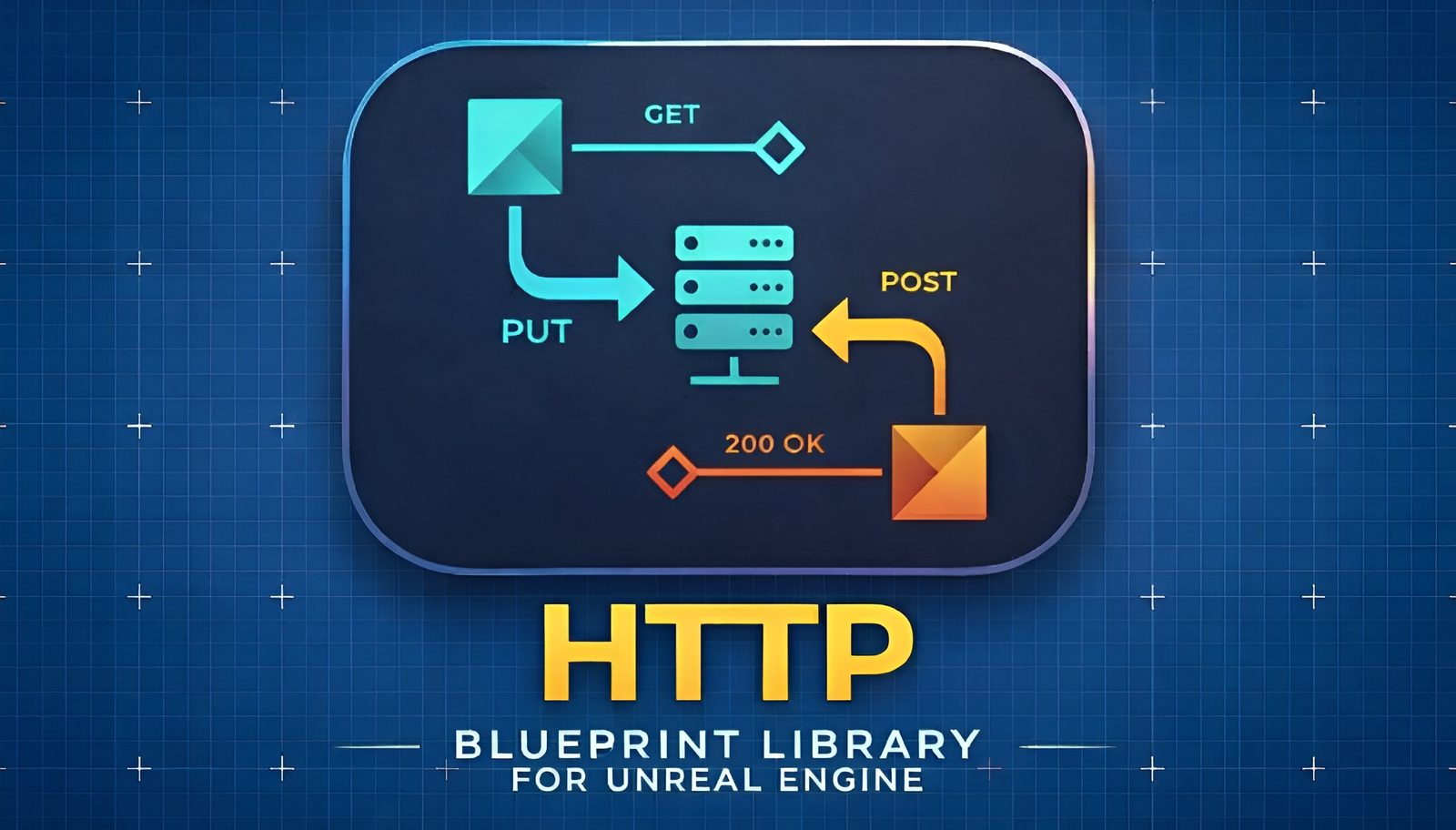
This is exactly the gap EasyHTTP is built to close. It is a Blueprint-friendly wrapper around the engine's own HTTP module, so GET, POST, PUT and DELETE — with headers, JSON parsing, four auth schemes and async success and failure callbacks — come as a handful of Blueprint nodes rather than hand-rolled C++ plumbing. It even ships a built-in local test server so you can build and verify your whole backend integration before the real API exists. The backend design stays your problem; the wiring to it stops being one. That is the right division of labour for a difficulty-4 system: spend your scarce attention on the architecture, and let tooling absorb the boilerplate beneath it.
Difficulty 5: the netcode wall
At the very top of the code kitchen, alone at a 5, sits authoritative real-time networking — and in our assessment it is the single hardest ingredient in any of the five kitchens, code included. This is the genuinely hard frontier: keeping a fast, fair, cheat-resistant shared world in sync across many machines over an unreliable internet, with an authoritative server arbitrating truth. Client-side prediction, server reconciliation, lag compensation, rollback, interest management, anti-cheat — these are not patterns you assemble, they are a research-grade systems discipline where a single subtle ordering bug can desync an entire match.
AI barely helps here, and the reason is structural rather than temporary. The systems below netcode are automatable to the degree that they are well-patterned and richly exampled. Authoritative netcode is the opposite: the correct solution is deeply specific to your game's tick rate, movement model, and threat model, the failure modes are emergent and non-local, and the body of clean, correct, copyable public examples is thin precisely because it is so hard to get right. A code assistant can explain the concepts and sketch a naive lockstep loop, but the part that matters — making it authoritative, responsive and cheat-resistant under real network conditions — is exactly the part that does not generalise from training data.
Netcode sits in a small group we call the things AI can't do — alongside game feel and juice at 5, level, puzzle and encounter design at 4, and the 'is it fun?' balance loop at 4. The pattern across all of them is the same: AI is strong wherever the work is patterned and weak wherever the work is judgement under your game's specific constraints. For most teams the right call is not to expect AI to write your netcode but to keep humans firmly on it, lean on a proven networking framework, and aim the time AI just freed up elsewhere at this part of the build.
Why the code kitchen splits so violently
Step back and the shape of the code kitchen tells a single coherent story. The average of 3.0 is almost meaningless on its own, because the kitchen is really two populations: a cluster of well-patterned systems down at 2 where AI is close to end-to-end, and a tail of judgement-heavy, context-specific systems climbing to 4 and 5 where it mostly advises. What separates them is not how 'advanced' the code looks but how much of the work is assembling known patterns versus making fine-grained decisions specific to your game.
That same logic explains why the code kitchen as a whole is harder than the content kitchens. Audio at 2.2, art at 2.57 and narrative at 2.78 are all more automatable on average, because a large share of their work is generative and pattern-rich — the exact thing current tooling is good at. Code straddles the line: half of it is that kind of patterned work, and half of it is the systems judgement that resists automation. Only polish and feel, at 3.75, scores harder, and tellingly its hardest ingredient, game feel and juice, lands on a 5 right next to netcode.
For anyone planning a build, the takeaway is to map your code work onto this ladder before you start. Hand the difficulty-2 systems to an assistant and move on. Use AI to scaffold the difficulty-3 systems, then reserve real time to tune them. Treat the difficulty-4 systems as places to spend your judgement and let tooling clear the boilerplace around them. And staff the difficulty-5 problem — netcode — with the humans who actually know it, because that is the rung where no amount of prompting closes the gap.
What this means for what you build
The practical conclusion is not 'AI can or can't code games' — it is that the easy half of the code kitchen has effectively been commoditised, and the hard half has not moved. Inventory, saves, menus, procgen, platform glue and in-house tools are increasingly a solved, low-margin problem that anyone can generate. The defensible work has migrated upward, into the systems where taste, balance, performance and real-time correctness still demand a human in the loop. If you are deciding where to invest your own scarce effort, invest it above the patterned tier, not inside it.
This maps neatly onto a finding from our wider Games-as-Recipes work: the most defensible niches are the ones whose core is the AI-hardest content. Deckbuilding is the standout example — the fastest-growing genre in our catalogue, with 64% of its titles released since 2023, yet our model rates it a systems-craft 3.18 because its core is balance, the work AI resists hardest. Highest demand crossed with the hardest-resisting core is exactly where a careful builder still has an edge. The same instinct applies inside the code kitchen: build where the difficulty-4 and difficulty-5 work lives, because that is the part competitors can't simply generate around you.
Concretely: let an assistant absorb the boilerplate, including the client-side plumbing of a difficult backend with something like EasyHTTP, so your hours go to the systems that actually differentiate the game. Render your live data well with a sibling tool like Fast Chart Widgets once it is flowing, keep your design contracts documented in-editor with Markdown 4 Blueprints, and keep a clear eye on which rung of this ladder each task sits on. The teams that win the AI-tooling era are not the ones that automate the most code — they are the ones that automate the right code and spend the saved time on the rungs nobody can climb for them.
The code kitchen, rung by rung
| AI-build difficulty | Code systems at this rung | What an AI assistant does |
|---|---|---|
| 2 | Inventory/crafting, save/settings/menus, procgen systems, platform integration, in-house tools | Carries it close to end-to-end; you specify intent and verify |
| 3 | Core gameplay loop, character controller, NPC AI, camera systems | Scaffolds fast, then you tune the feel by hand |
| 4 | Combat system, backend/live-ops, performance optimization | Advises and helps; the design and judgement stay human |
| 5 | Authoritative real-time netcode | Barely helps; expert, game-specific systems craft |
AI-build difficulty is our editorial assessment of what code tooling can do today (1 = near end-to-end, 5 = expert real-time craft). It rates automatability of the parts, not whether the game is good.
How the five kitchens compare
| Kitchen | Average difficulty | Hardest ingredient (difficulty) |
|---|---|---|
| Audio | 2.2 | Adaptive/interactive music (4) |
| Art | 2.57 | 3D characters game-ready / environment art / skeletal animation (4) |
| Narrative | 2.78 | Level, puzzle and encounter design (4) |
| Code | 3.0 | Authoritative real-time netcode (5) |
| Polish/feel | 3.75 | Game feel/juice (5) |
Average ingredient difficulty per kitchen in our buildability model (editorial). Lower = more automatable on average.
FAQ
Can AI code an entire gameplay system on its own?
For some systems, nearly. In our buildability model the patterned systems — inventory and crafting, save/settings/menus, procgen, platform integration and in-house tools — all score a 2, meaning an AI assistant can carry them close to end-to-end while you specify intent and verify correctness. For harder systems like combat, backend or netcode, AI advises and scaffolds but does not lead. These scores are our editorial assessment of current tooling, and they rate how automatable the parts are, not whether the result is fun.
What gameplay system is hardest for AI to build?
Authoritative real-time netcode. Our model rates it a 5 — the single hardest ingredient across all five kitchens. Keeping a fast, fair, cheat-resistant world in sync across many machines over an unreliable network involves client-side prediction, server reconciliation, lag compensation and anti-cheat, where the correct solution is deeply specific to your game and the failure modes are emergent. AI can explain the concepts but barely helps with the part that matters.
If AI can write inventory and save systems, should I still build them myself?
You should still own the intent and verification. The reason these systems score a 2 rather than a 1 is that an assistant will happily serialise the wrong fields or get a crafting recipe subtly wrong; the code is cheap, but knowing what it should do and checking that it does stays with you. The bigger implication is strategic: when anyone can generate a competent inventory system in an afternoon, the system itself stops being a moat, so your edge has to come from polish, integration or a sharper problem.
Where does AI help most with a game backend?
With the plumbing, not the architecture. Backend and live-ops scores a 4 in our model because the hard part — API design, sharding, exploit-resistant economies, live-ops that don't break older clients — is judgement-heavy systems work. But the client-side wiring is mostly difficulty-2 boilerplate: HTTP requests, JSON parsing, auth and retries. A tool like EasyHTTP turns that wiring into a few Blueprint nodes and even ships a local test server, so you spend your effort on the architecture rather than the plumbing.
Does a low AI-build difficulty mean the system will be good?
No. AI-build difficulty measures how automatable the parts are, not whether the result is good or fun. A system can be easy to generate and still feel terrible — a character controller scores a 3 because AI nails the scaffold but the coyote time, jump buffering and acceleration curves that make it feel good are taste-driven tuning that no prompt produces. Buildable is not the same as good.
EasyHTTP
GET, POST, PUT and DELETE with headers, JSON parsing and async callbacks — REST APIs in a few Blueprint nodes. Talk to web services, backends and game APIs without touching C++.
Related on Fab

Related reading