article · 2026-06-24
Building a Visual Novel With AI: The Most Buildable Commercial Game
It scores 1.80 in our buildability model — the lowest of any genre, with no core ingredient AI can't already do. The only job left is taste.
Which commercial game is the easiest to build with AI today?
If you want to ship a real game and hand as much of the work as possible to AI tools, there is a clear answer, and it is not a guess. In our Games-as-Recipes study we broke a game down into roughly 45 reusable ingredients, scored each by how much of it a generalist can hand to AI today, and rolled those scores up into a single buildability number for each genre. Lower means more automatable. The visual novel comes out at 1.80 — the lowest score of any genre we assessed, the single most AI-buildable commercial format that exists.
That number is our editorial judgement about what current tooling can do, not a measurement of anything, and it deliberately says nothing about whether the result is any good. But on its own terms it is unambiguous. A 1.80 means every core ingredient of the genre sits in AI's strong zone, with nothing dragging the average up. There is no other commercial game type where that is true.
Two close cousins sit just behind it for the same reason: interactive fiction at 1.83 and point-and-click at 1.94. All three are content-first formats — pictures, words, and a thin shell of code — and content is exactly the half of game-making that AI has nearly solved. If your goal is buildability above all else, you are choosing between these three, and the visual novel is the front of the queue.
Read the recipe: why the visual novel scores 1.80
A buildability score is only as honest as the recipe under it, so here is the recipe. A visual novel is, mechanically, a stack of style-locked 2D illustrations and backgrounds, a branching dialogue tree, a body of worldbuilding and lore, voiced lines and music over the top, and a save-and-menu shell to hold it all together. Walk that list against our feature ledger and something striking happens: not one core ingredient scores above a 2.
In our buildability model, 2D backgrounds score 1 and concept art scores 1 — the most automatable art there is. 2D illustration scores 2. On the narrative side, flavour text scores 1, while branching dialogue and worldbuilding both score 2. On audio, voice acting scores 1 — we rate it the single most-automated craft in games — with music at 2. And the only real code a visual novel needs, the save, settings and menu systems, scores 2. Add it all up and there is simply no ingredient in the build that resists automation.
Contrast that with a 2D platformer, which scores 2.91 in the same model despite generating its art and music just as easily. The difference is the core: a platformer's identity is controller feel, level design and juice — three of the things AI is worst at. The visual novel has no such hidden hard ingredient. Its core is the content, and the content is the part AI builds best.
The audio is the part people underestimate
Most people who hear 'AI can build a visual novel' picture the art and the writing. The part that surprises them is the voice. In our buildability model, voice acting scores a 1 — we rate it the most-automated craft in the whole medium — and a fully voiced cast is exactly what lifts a visual novel out of the slush pile. Music sits at 2, sound effects at 2, ambient soundscapes at 2. The entire audio kitchen averages 2.2, the lowest of the five.
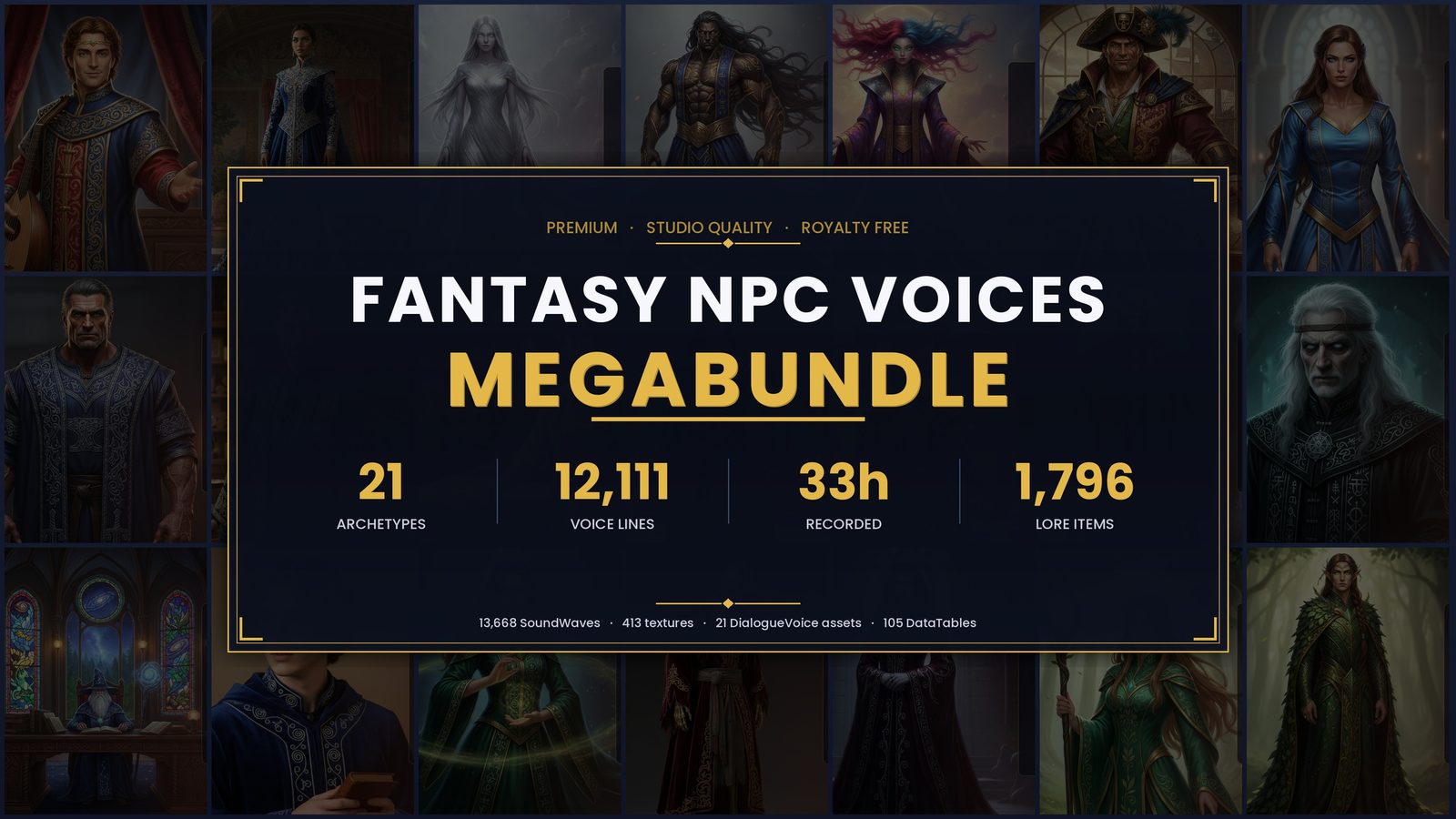
There is a practical fork here, though, and it is the one place a content pack earns its keep. Generating voice with AI tools gives you infinite, instant, cheap lines, but you carry the curation burden yourself — every line has to be auditioned, and consistency of character across a long script is real work. A pre-recorded library trades that for ready-made coherence. Our Fantasy NPC Voices megabundle is roughly 33 hours of dialogue across 13,668 voiced WAVs at 44.1 kHz, spanning paladins, vampires, witches, wizards, bards, goblins and necromancers — enough to voice an entire fantasy cast without auditioning a single take.
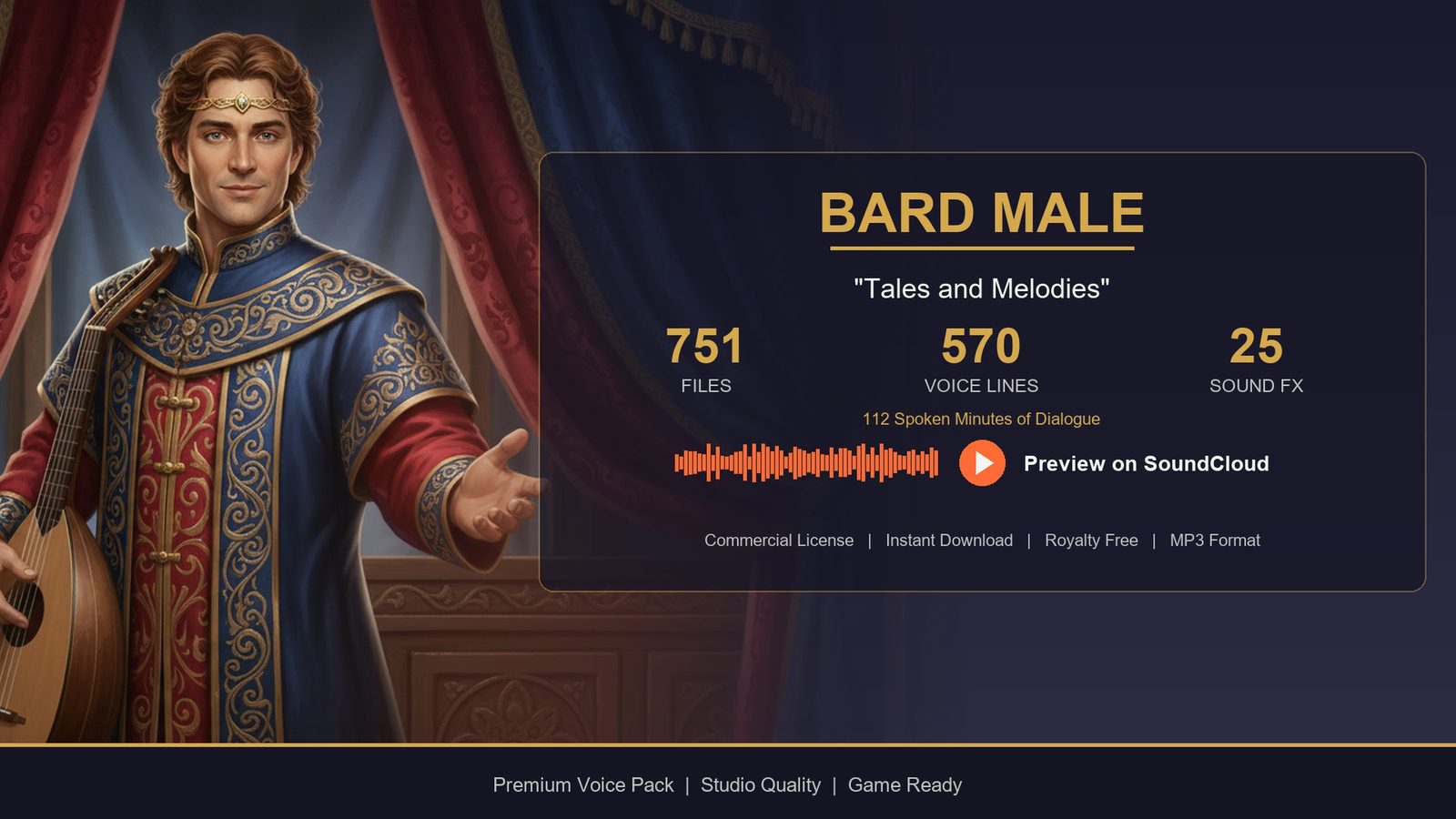
For a smaller, single-archetype project the same logic scales down. The Bard Dialogue Pack is 112 minutes of quest-giver and travelling-minstrel banter you can drop straight into a dialogue system. Whether you generate, license, or mix the two, the point the data makes is the same: audio is no longer the bottleneck it used to be for a project this size.
The art recipe: 500 portraits, keep 50
The visual side of a visual novel is mostly two things: character portraits and backgrounds. In our buildability model backgrounds score a 1 and the illustration that carries the characters scores a 2, which means text-to-image tooling can produce the entire visual surface of the game faster than you can name the cast. The constraint stopped being 'can I make this picture' some time ago. It is now 'which pictures, and do they hang together'.
That reframes the human job entirely. The work is no longer drawing — it is selecting and style-locking. You generate hundreds of portraits and keep the handful that share a consistent face, palette and rendering across every expression and pose your script demands. A realistic ratio is brutal: you might generate five hundred candidates to keep fifty. The taste to make that cut, and the discipline to enforce one visual language across the whole game, is most of what separates a coherent visual novel from a bag of mismatched AI images.
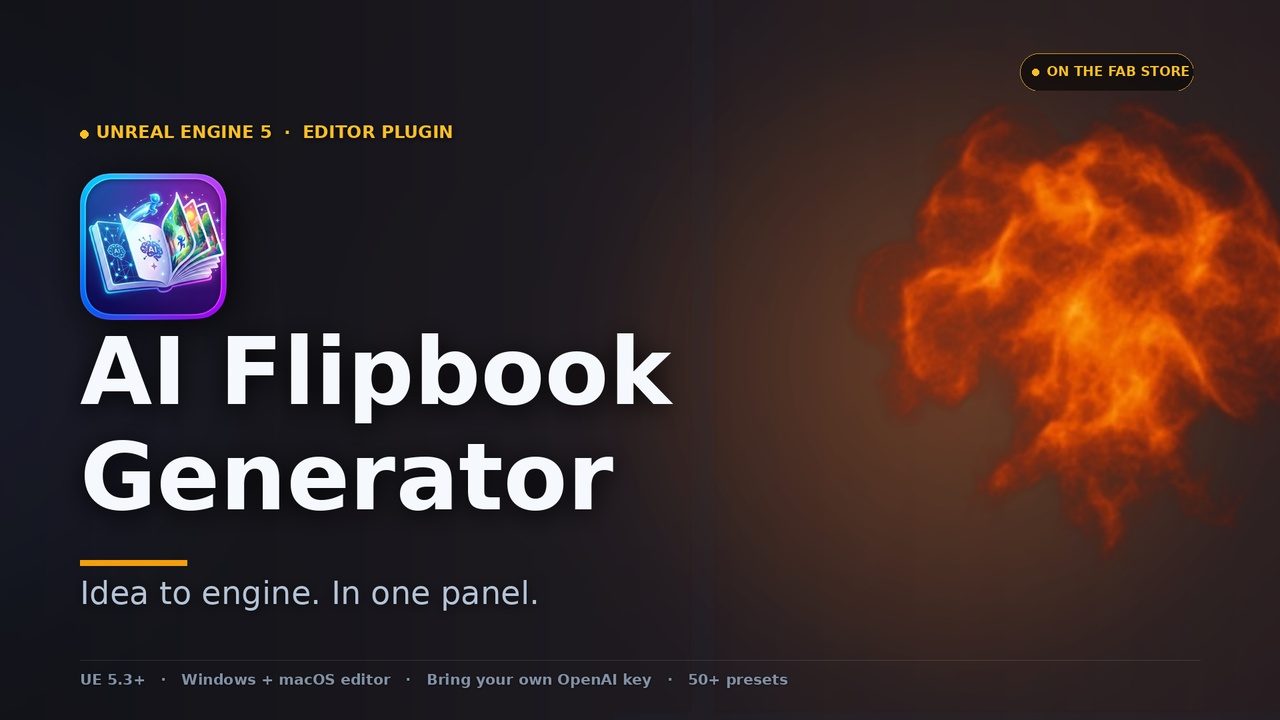
If your visual novel leans on effect moments — a spell going off, a transition flourish, a title screen that moves — the same generate-and-curate workflow extends into motion. Our AI Flipbook Generator turns a text prompt into a game-ready Niagara spritesheet inside the editor, baked to a Texture2D, Material Instance and Niagara System, so even the animated punctuation of the game comes out of the same prompt-and-pick loop as the stills.
The one thing the score can't tell you
Here is the caveat that has to ride alongside every number in this piece: a buildability score measures the automatability of the parts, not the quality of the whole. 'Buildable' is not 'good'. The 1.80 tells you that you can assemble a visual novel almost end-to-end with AI tools. It tells you nothing about whether anyone will want to read it.
And that is the rub, because the thing AI cannot supply for a visual novel is the one thing the genre is actually judged on. A visual novel lives or dies on whether the writing has a soul — whether the branches matter, whether the characters are people you care about, whether the prose earns the hours it asks for. Branching dialogue scores a 2 in our model as a production task: the AI can draft serviceable lines all day. Whether those lines add up to a story worth finishing is a different question, and it is the human's question.
So the remaining human job in the most buildable game on the board is not technical at all. It is editorial. It is which fifty of five hundred portraits you keep, which voice takes you trust, and — above everything — whether the script is alive. Everything else, the data says, you can hand to a tool.
Buildable and crowded: what 1.80 does and doesn't buy you
There is a trap hidden inside the easy column, and it is worth naming before you commit. If a generalist can build a visual novel in a few weeks, so can everyone else. Buildability on its own is not an opportunity — it is a commodity. The visual novel is the most buildable genre precisely because nothing about its production resists automation, which is the same reason it is one of the most contested.
The MythicLemon Games Catalogue holds 5,481 visual novel titles, with 37% of them released in 2023 or later — a large, actively-supplied field. That is not a reason to avoid it, but it is a reason to be honest about where your edge comes from. It will not come from having built the thing; the build is the cheap part now. It will come from the part the score can't automate: a premise worth telling, a cast worth remembering, and a visual and vocal identity held consistent across the whole game.
If you want the same low build cost with a thinner shelf, the two neighbours are worth a look. Interactive fiction scores 1.83 — pure writing, AI's single strongest domain — across 3,137 titles with 48% released since 2023, the freshest momentum of the three. Point-and-click sits at 1.94 across 5,198 titles. All three let AI carry the production. None of them let it carry the soul.
How to actually build one: a practical order of operations
If you are convinced, build in the order that protects the only scarce resource you have — your editorial attention. Write first. The script is the spine of a visual novel and the one ingredient no tool can finish for you, so get the branches and the characters working on the page before you generate a single asset. A great script with placeholder art beats gorgeous art wrapped around a hollow one, every time.
Then lock a visual language before you mass-generate. Decide the palette, the rendering style and the framing once, nail one hero portrait you love, and use it as the reference everything else is style-matched against — otherwise you will drown in five hundred beautiful, incompatible images. Generate backgrounds and the supporting cast against that anchor, and curate ruthlessly. Layer audio next: voice your principals, score the key beats, and let the catalogue or your generator fill the long tail. Save the menu, settings and save-system shell for last; in our model it is a 2, the most predictable work in the project, and it should never be what blocks you.
Throughout, treat AI as the production line and yourself as the editor-in-chief. The data's whole point is that the labour of making a visual novel has collapsed, while the craft of making a good one has not. Spend the time you saved on production on the one thing that was always going to decide it — whether the thing is worth reading.
The three most AI-buildable genres
| Genre | Buildability (lower = easier) | Titles | Released 2023+ |
|---|---|---|---|
| Visual Novel | 1.80 | 5,481 | 37% |
| Interactive Fiction | 1.83 | 3,137 | 48% |
| Point & Click | 1.94 | 5,198 | 37% |
Buildability is our editorial assessment of how much of each genre a generalist can hand to AI tools today (1-5, lower = more automatable). Title counts and recency are from the MythicLemon Games Catalogue.
The visual novel recipe, ingredient by ingredient
| Ingredient | Kitchen | AI-build difficulty |
|---|---|---|
| 2D backgrounds | Art | 1 |
| 2D illustration (portraits) | Art | 2 |
| Flavour text | Narrative | 1 |
| Branching dialogue | Narrative | 2 |
| Worldbuilding / lore | Narrative | 2 |
| Voice acting | Audio | 1 |
| Music | Audio | 2 |
| Save / settings / menus | Code | 2 |
Every core ingredient of a visual novel and its AI-build difficulty in our editorial model. Nothing scores above a 2 — the reason the genre lands at 1.80.
FAQ
What is the most AI-buildable type of game?
In our Games-as-Recipes study the visual novel scores 1.80, the lowest of any genre — meaning the most automatable. Every core ingredient sits in AI's strong zone, with nothing above a 2: style-locked illustration and backgrounds, branching dialogue, worldbuilding, voice, music and a save-and-menu shell. The score is our editorial assessment of current tooling, not a measurement, and it rates the parts, not whether the result is good.
If AI can build a visual novel, what's left for me to do?
Taste, and writing. The score measures the automatability of the parts, not the quality of the whole — buildable is not good. AI can draft the dialogue and generate hundreds of portraits, but you still choose which fifty of five hundred to keep, enforce one consistent visual and vocal identity, and decide whether the script has a soul. That editorial job is the entire game once production is automated.
Should I build a visual novel or interactive fiction?
Both are near the top of our buildability ranking — visual novel at 1.80, interactive fiction at 1.83. The visual novel adds an art layer AI handles easily; interactive fiction is pure writing, AI's single strongest domain, and carries the freshest momentum of the group at 48% of its 3,137 titles released since 2023. Pick the visual novel if visuals are central to your story, interactive fiction if the words can carry it alone.
How do I handle voice acting for a visual novel?
Voice acting scores a 1 in our buildability model — the most-automated craft in games — so AI voice tooling is one option, at the cost of auditioning every line yourself. A pre-recorded library is the other: our Fantasy NPC Voices megabundle is around 33 hours across 13,668 voiced WAVs spanning the full fantasy roster, and the smaller Bard Dialogue Pack is 112 minutes of quest-giver banter. Generate, license, or mix the two.
Is the visual novel a good business opportunity because it's easy to build?
Not by itself. Buildability is a commodity — if a generalist can build one, so can everyone else, and the catalogue already holds 5,481 visual novels. The 1.80 lowers your cost, not your competition. Your edge has to come from the part the score can't automate: a premise worth telling, a memorable cast, and a consistent identity held across the whole game.
Fantasy NPC Voices
The complete fantasy voice megabundle: roughly 33 hours of dialogue across 13,668 voiced WAVs at 44.1 kHz — paladins, vampires, witches, wizards, bards, goblins, necromancers and more. One library to voice an entire RPG cast.